Vlad The Bad


February 25th, 2022 –

If one has studied Russian History, you will discover a long line of Czars and bad guys and bad gals starting with Ivan the Terrible and passing on to Peter the Great, Catherine the Great & Stalin. And if one looks at what these different people did, one fact seems to stand out…they all increased the size of the Russian empire and they all were concerned with having ample land surrounding their empire. One could say that having satellite countries is built into the DNA of Russia.

Enter Vlad the Bad. Vladimir has been with us for a while, first as a KGB agent, later as Premier and President of Russia. In truth, Vlad the Bad is just another Czar who has spent a lifetime consolidating power and increasing the size of the Empire. Czar Vlad’s view may be a little short-sighted when compared to his predecessors: he looks back to the glory days of the Soviet Union and seemingly considers that the apogee of Russia. No doubt, earlier Czars and Czarinas would disagree with him on that point. They might think that the former Communist Empire was a step down in elegance, glory and achievements of previous Czars and Czarinas.

This same view may be harbored by the Russian people themselves, but no matter, you go to war with Czar you have, not Czar you wish you had.

For those of you not familiar with Russian History it should also be noted the Ukraine, Kyiv and the Dnieper River have long played major roles in the history of Russia. So, if you are thinking that Vlad the Bad is the first Russian to think that the Ukraine was a part of Russia, you would be wrong. The Ukraine has been thought by Russians to be a part of Russia for over a 1,000 years. For as long as there has been a Russian Empire and an area known as the Ukraine, Russians have thought that the Ukraine is Russian.

This is not say that the people living in the Ukraine have the same view of history. Like Jerusalem, the history of the Ukraine is far more complicated. True, the Ukraine was an original part of Russia dating back to the 9th century, but after that it was under various masters. The days that Vlad the Bad fondly remembers was when the ”Iron Curtain” had descended and the Ukraine was fully under the control of Mother Russia. First and foremost, the people living in Ukraine did not necessarily have the same fond memories of the Good Old Days of the Cold War. Perhaps, they remembered some shortages in supermarkets or in nylons for the ladies.

But time and history move on and The Wall did fall and the former satellite countries of the Soviet Union became more interested in enjoying their lives and in having some say in their destiny. And other things were happening in the world. The EU was founded in 1993 and like any growing organization they sought new members to augment their numbers. Now it must said that that there was a guy named George Kennan who formulated for the United States a theory of containment for the Soviet Union. George quite correctly said that the Soviet Union would never be happy unless it had its satellite countries. And shortly before George died, he said that European and Western diplomats had screwed up everything and not understood Russia’s need for satellite countries and surely trouble would come from that.

Certainly, George was right about that but as with all things that have happened it must be remembered that they are in the past and the past is the past. So, pushing forward to the present moment, you can say there may be some reasons why Vlad the Bad is being bad and that it all could be explained as just being in Czar Vlad’s DNA. So this is the moment we are at. The U.S. and Europe can say there is no justification for Putin’s ”War of Choice” and Putin can simply say the answer is history itself and I need my Ukraine.

So where will all this go? Nobody can know. Calmer and more mature and perhaps, more naive minds can hope for a diplomatic settlement. More realistic folks can hope that the invasion is swift and clean and not too many people are murdered. More pessimistic folks can hope we avoid World War III. Still more pessimistic folks might just say things come in 3s.

Xi Orders Omicron To Go Away

February 16th, 2022 – Today President Xi ordered Hong Kong officials to get the recent surge of the Omicron wave of Covid under control in that city. The city of Hong Kong has just announced 4,200 new Omicron cases and 3,000 new suspected Omicron cases.

President Xi said,

“Hong Kong’s government must take up the main responsibility to stabilize and control the pandemic as soon as possible as a mission that overrides everything, mobilize all available forces and resources and take all necessary measures to ensure the safety and health of Hong Kong’s citizens and the stability of Hong King’s society.”

Some news organizations speculate that China may soon order a total shutdown of Hong Kong and the adjacent new territories. The population of Hong Kong is roughly 7,500,000 people. The population of the new territories is roughly another 3,600,000 people. So, 11 million or so folks may soon find themselves in lockdown.

As many of you may know, China has Zero Covid policy and that has not been easy. China has routinely shut down cities with millions of people living in them when only one or two Covid cases were found. The situation in Hong Kong appears to be of a different magnitude and obviously Emperor Xi is somewhat concerned.

Throughout history various Kings, Emperors, Dictators and Leaders have decreed unpleasant things to go away. The English King Canute in the 12th century commanded an incoming tide to halt and not wet his feet and robes. To Canute’s surprise, the tide kept coming and his feet and robes got wet. That encouraged Geoffrey Chaucer to say a few hundred years later ”time and tide wait for no man”.

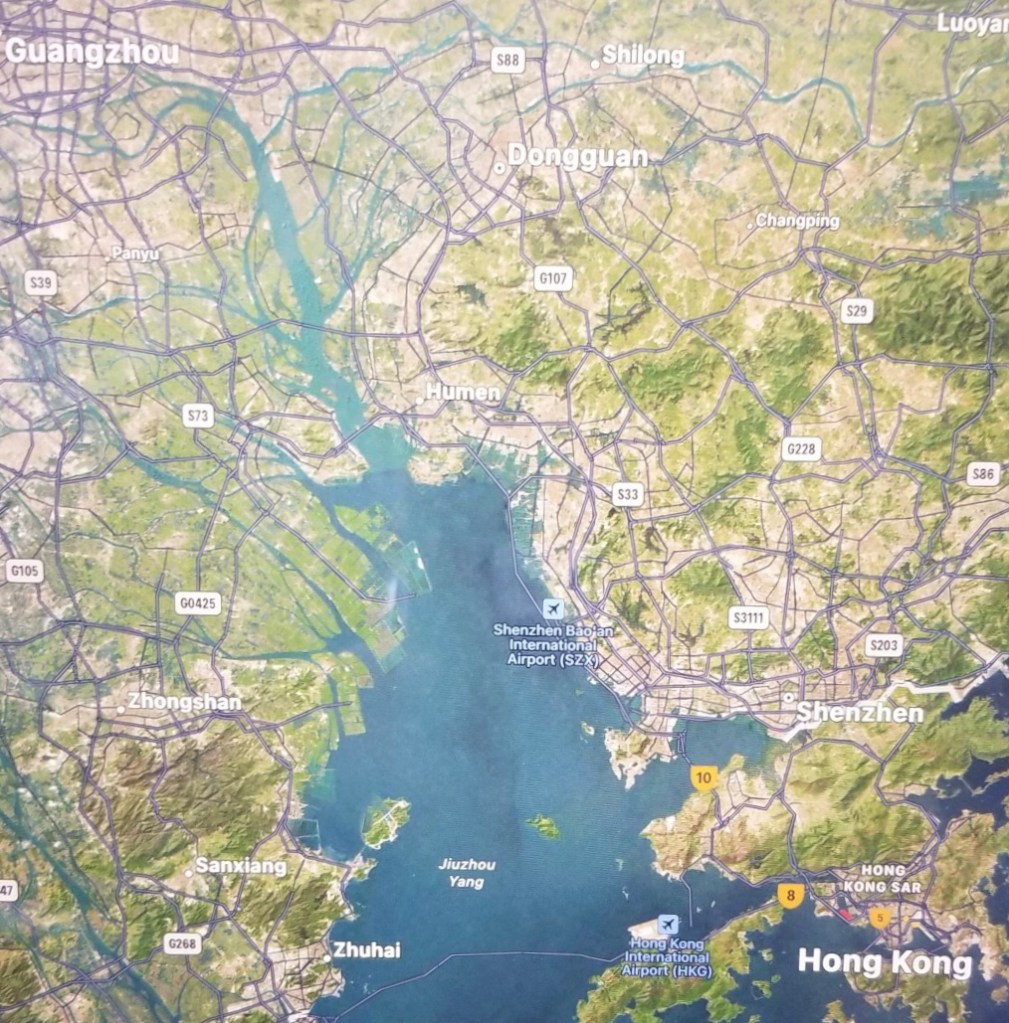
BCE (aka Buffalo Chip Express) would like to point out that Hong Kong is situated on the Pearl River and adjacent to a number of large mainland China cities. Locally, that area of Southern China, is considered to be one giant ”sea city” of 50,000,000 people. As many travelers to Hong Kong know, there is a lot of people going back and forth between Hong Kong, Shenzhen, Dongguan and Guangzhou and these four Chinese cities are all within 50 miles of each other.

BCE speculates that it could happen that the dread Omicron epidemic now spreading through Hong Kong could also spread to the adjacent cities of Shenzhen, Dongguan and Guangzhou. BCE might make an additional guess and say that if that does happen, the Omicron virus may spread throughout the mainland of China this coming spring and summer.

If that were to happen, it could be thought by some in China that President Xi, the present Emperor of present Chinese dynasty, has no clothes.

2 Theories on Why Prices May Go Down


February 15th, 2022 – There are two interesting theories on why prices may go down in the coming months. These two theories are promoted widely by prominent pundits, financial advisers, TV business commentators, economists, bankers, stock market mavens and other like-minded folks.

Prices will go down because inventories are presently at an all time high.

High prices will go down as the disruptions caused by the Pandemic go down.

Let us consider the first theory – inventories are at an all time and therefore prices will go down. First, it is not quite true. In December inventories of all unsold goods reached 789.4 billion. That was 2.5% increase over November, but actually that was a decrease over inventories in October, 2021. No matter, it is beyond dispute that inventories were historically high in December, 2021.

That said, BCE (aka Buffalo Chip Express) asks why would that decrease prices in the future? BCE knows the theoretical answer to that question. It goes like this: Because inventories are historically high, sellers of goods will be forced to reduce prices on those goods. BCE admits it may be quite true that having too much inventory of a product at one time may force some sellers to reduce prices in order to sell down those high inventory items, improve cash flow and be able to buy other goods, but BCE would suggest that does alter the fact that those goods were produced at higher prices. And more particularly, that does not, in itself, reduce the future cost prices to replace those products in the future.

So, BCE would agree that high inventories may force some sellers to reduce the prices of some products temporarily, but that does not change the cost of producing new goods in the future, nor does it mean that prices will not again go up in the future for those products. Finally, just having high inventories of some products does not mean they will reduce prices on those products at all. Sellers may just hold those products in stock until they they are sold at the higher prices they have passed on.

The second theory is as the Pandemic and the disruptions it caused wind down, price increases will go down with it. BCE sees 2 problems with this idea:

It is not clear that the Pandemic or the disruptions it caused will go away. While it is clear that the Pandemic is presently winding down from the present winter surge in the U.S., it is not clear or knowable that there will not be further surges or new variants of the Pandemic to cause further disruptions. In addition, it is not clear that disruptions in Asia and Europe and other places around the world will go down and will not suffer further surges or variants in the future.

In particular, it is clear that the Pandemic is surging rapidly in Hong Kong and may spread soon to all of China and that would almost certainly guarantee further disruptions of production and shipment of goods. And if that were to happen, it would add further pressure on prices. It is not clear that even if the Pandemic and disruptions from it declined, there would be any reductions in the cost of goods or the cost of shipping goods. In fact, if the Pandemic recedes and disruptions cease, it may cause further price increases because the reopening of economies cause a major increases in the demand for goods.

Again, people can speculate that prices may magically go down, but they will never know if prices will magically go down until that actually happens.

Inflation Nation

February 10th, 2022 –

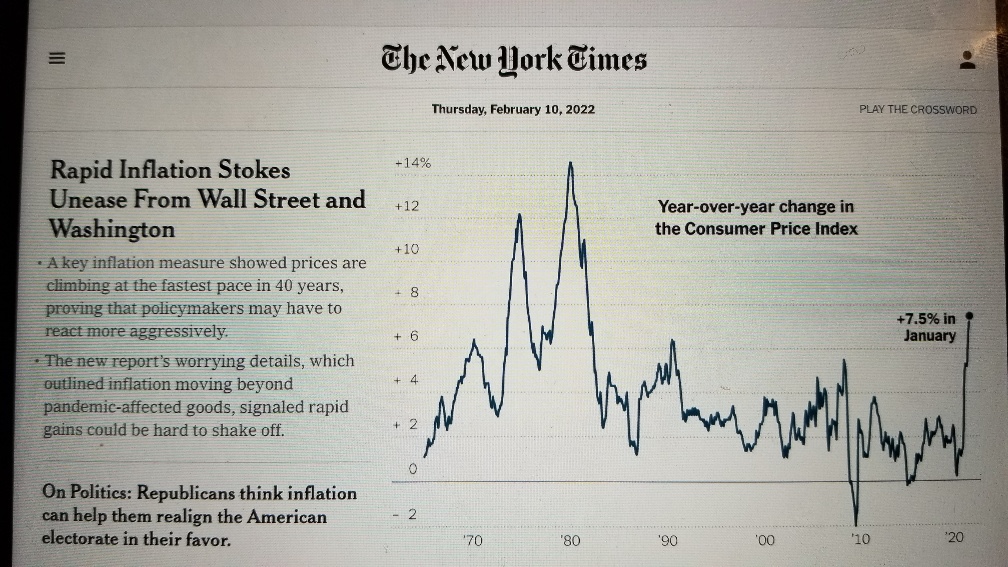
Today it was announced that inflation for last month, January, surged 7.5%. The experts, the pundits, the stock market mavens had forecast anywhere from 5% to 7.2%. Surprise, surprise – inflation turned out to be like that ornery child who refuses to behave. It was supposed to go down slightly, but it actually sped up.

Until recently, the Fed had proclaimed inflation “transitory”. Chairman of the Fed, Jerome Powell, retired the word “transitory” at the end of November when it became apparent that inflation was increasing rather than decreasing. Apparently, the Chairman was surprised that inflation was actually accelerating. Who knew?

As one can see from this chart, inflation has varied greatly in the last fifty years. Inflation was pretty high in the 70s and early 80s and then it calmed down for almost 30 years until a couple of months ago.

There are many reasons for inflation:

Cost of materials went up worldwide, increasing the cost of producing products worldwide. Cost of shipping products went up worldwide. The Pandemic caused unemployment and shutdowns that slowed production of many products worldwide, adding to the costs of producing products.

With advent of the Pandemic, the U.S. Government launched large relief packages to assist people and companies, literally printing and dispersing billions of dollars. The increase in the printing of money increased the yearly deficits of the United States, but it also devalued the currency because the added spending was not offset by added income to the government.

And because inflation increased rapidly in the United States, many workers requested and held out for wage increases. And because businesses had difficulties hiring and getting people, they were forced to increase the wages they paid. At the same time, the people accepting new jobs at higher wages quickly found the price increases of everyday products they bought was accelerating faster than their salaries.

All of these factors had an influence on the prices of products and services in the United States. It was thought by the best and brightest in the economic community that these increases were short-term or in the words of Chairman Powell, “transitory”. But as mentioned, right up to this week, inflation had the nasty habit of increasing rather than decreasing.

The best and brightest of the economic community still believe that increases are only “transitory” and almost all forecasts are for inflation to sharply decrease by year end.

BCE, aka Buffalo Chip Express, would like to suggest that the predictions of a sharp decrease of inflation by year end may not happen.

BCE would like to suggest that the higher cost of goods and services and materials and wages may only be beginning.

BCE would like to mention that when goods are produced in other countries, the manufacturers of those goods pass on higher costs only as they occur. And in truth, exporters only began to pass on higher prices about 6 months ago. However, the companies importing and selling those goods in the United States did not raise prices immediately because they had stock of goods already bought at lower prices. Most companies try to raise prices only once a year. So, most companies only began their price increases of imported goods in January of this year.

BCE would like to also mention that just because an importer has announced price increases, that does not mean the price of the goods go up immediately in stores. That is because stores also have inventory and they tend to raise their prices only as they receive new goods that they have to pay more for. So, the process of passing on price increase takes time and BCE would suggest that many price increases announced by exporters 6 months ago will only show up in retail outlets at the consumer in the next 3 months.

Of course, not all goods sold in the United States are imported. We still do manufacture a lot of goods, but in manufacturing, a lot of inflationary factors are also at play. The fact that we are still in Pandemic has greatly added to the costs of manufacturers, because they have experienced added costs for the times they have had to shut down, for the times they had people out sick, for the increases in wages that they have to pay, for the increases in shipping costs both shipping parts and materials to them and shipping finished goods to their customers. And, of course, they have had to pay increased prices of materials and parts that they need for the production.

So U.S. manufacturers have seen many costs rise and are still seeing costs rise. And manufacturers, like importers, generally only pass on price increases when price increases are passed on to them. But make no mistake: they must pass on price increases if they are to be profitable and remain in business.

BCE would like to note another factor looming over the U.S. economy and that is the price of oil. On the same day that the government announced 7.5% inflation, the price of oil hit $90 several times that day. The price of oil has in the last 18 months increased from a low of $40 to the present high of $90+.

Those of you familiar with what is known as the “driving season” might remember that the price of oil has a mysterious tendency to increase in the spring and summer when most people drive a lot. This coincidence seems to occur fairly consistently over the last 50 years. And, of course, if it was to occur this year, it would probably mean that the price of oil is about to head up the mountain on a journey from $90+ to $130+ or more.

Of course, history and coincidences don’t always occur, but they do, as Mark Twain noted, tend to rhyme. So, BCE guesses that we will see a further sharp rise in the price of oil this spring and summer. As most you know, that probably means that the price of gas, presently anywhere from $2.50 a gallon to $4.50 a gallon, might be $5 to $7 this summer.

Economists speak of oil shocks, but this truly would be a “gas shock”. No change like the above comes about without creating other changes. As people notice the price of gas going up weekly they will realize that inflation is taking more and more of their salary and as that happens there will be an increase in the demand for higher wages. So, the likelihood is that manufacturers and stores and hospitals and hotels and convention centers and water parks and airlines and banks and all other businesses will find themselves with employees wanting more wages.

BCE would like to point out that the difficulties from an oil shock and a gas shock do not stop there. Plastics are a derivative of oil and so all parts and any products made using plastic are likely to go up sharply this spring and summer. And of course, all of these price increases will only start feeding into our economy this spring and summer. And because the lag time between material price increases and product price increases is long, the real impact may only be felt in the fall of this year and in the first 6 months of 2023.

To summarize, BCE thinks the thought that prices will moderate sharply in the coming months is Buffalo Chips.