The new government has been elected and rich folks are going to fix things for poor folks.
We are talking inflation…it’s going to go down, down, down. We are talking government waste…it’s going to disappear. We are talking “The Swamp”…it’s going to be drained. No more graft and corruption…no more Coastal Elites telling Americans how they should think or what bathrooms to use.
But that’s not all, the economy is going to get better. Everybody is going to earn more money and nobody is going to have their jobs taken away by illegal aliens. America is going to get its country back. America is going to be Great Again.
And what about those 11,000,000 illegal immigrants or maybe it’s really 20,000,000 illegal immigrants. Whatever! They are going back home to the country they came from…starting January 20th, 2025. The new Administration will have gone in no time. The planes, the buses, the taxis, the Ubers are being scheduled right now.
And the stock market is going to boom like never before and BitCoin is going to $200,000 and we won’t have to take those nasty vaccines that never worked anyway. Yes, good times are coming.
As you can see from this screenshot above, some of the smartest and richest people in America are going to make life more prosperous for all of us. Yes, this is a time to buy, buy, buy and get invested in the coming booms…in oil, in AI, in Crypto.
The New Trump Administration has already selected its new cabinet. Of course, there will be some discussion in the Senate about some of the new picks, but after one or two bumps in the road, it will be smooth sailing from there. And then there will be a whole new way of looking at things. A new FBI, a new DOGE, a new more efficient Government with Trillions of dollars saved. Best of all, some of the richest people in the world will be using their brain power and their resources to help the poorest Americans.
And there there will be tax cuts galore…no more Salt taxes, no more taxes on restaurant tips, no more taxes on Social Security and the tax savings for the poor will be really HUGE.
If inflation is coming down, why are prices going up?
There has been a lot of debate about inflation. A lot of pundits, politicians and economists have chimed in on the subject. Recently, many economic experts have claimed that inflation is coming down.
Well, yes and no. The Rate of Inflation is coming down and some isolated prices have come down, but most prices are still going up.
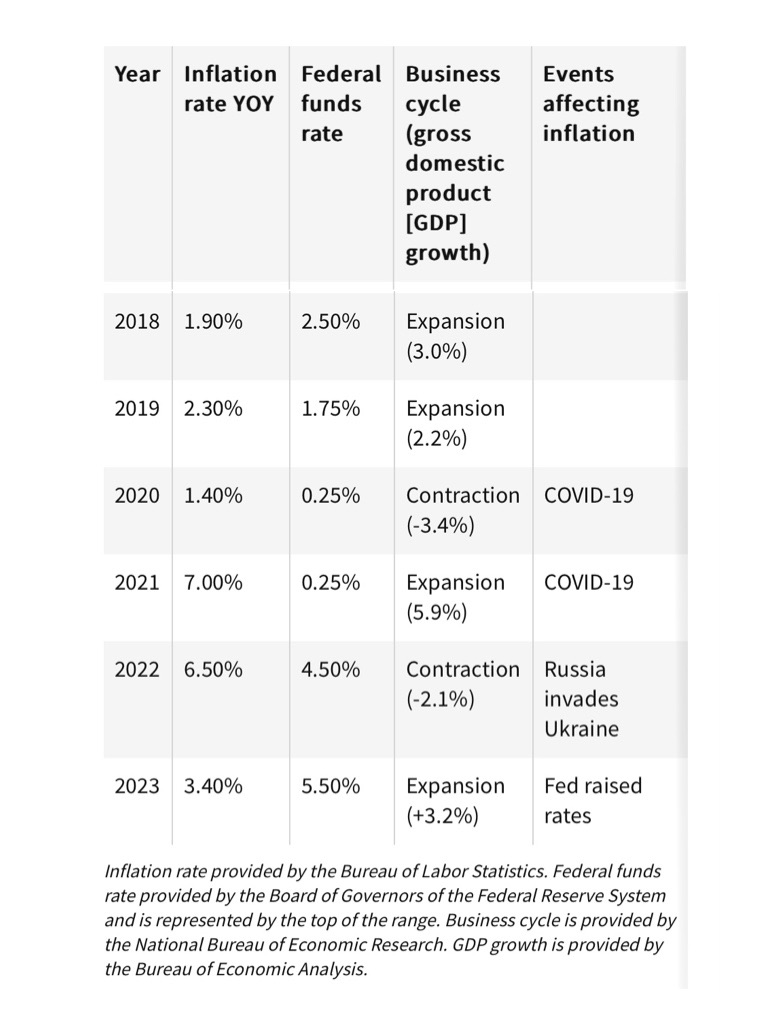
Below is a chart of inflation for each year from 2018 to 2024 along with some information about interest rates, gross domestic product in each year and mention of two events that have influenced those numbers. As you will see from the chart, inflation was very quiet up until the year 2021. Then, it jumped up sharply in 2021 and 2022 and then went down in 2023. So far, inflation in 2024 was 3.1% in January, 3,2% in February and 3.5% in March – so inflation is running about 3.25% so far this year.
This shows inflation from 2018 to 2023. As you can see it was low in 2018. It went up a little in 2019 and then back down in 2020. And it really went up in 2021 and 2022. In 2023 inflation went back down from 2022.
The numbers above do not seem to explain why prices are so much higher in 2024 than 2019 or why when inflation is coming down, prices are going up.
NEWS FLASH #1: Inflation is Cumulative!
Let us explain: if a group of products cost $100 in 2018 and then we apply the rate of each year from 2019 to 2024 is to the $100, here is what happens:
2019 – $100 x 1.023 = $102.30
2020 – $102.30 x 1.014 = $103.73
2021 – $103.73 x 1.07 = $110.99
2022 – $110.99 x 1.06.5 = $118.21
2023 – $118.21 x 1.034 = $122.23
2024 – $122.23 x 1.0325 = $126.20
So, by this math, what costs $100 in 2018, now costs $126.20 in 2024. Of course, that is only for an average of $100 of supposedly typical products. As you can see from the picture of a chart at the top of this blog story, many different other products are up much, much more.
Who knew?
NEWS FLASH #2: Inflation Tends to Feed On Itself!
What is not often mentioned by economists and politicians who may be hopeful of different results, once inflation begins it historically tends to feed on itself. That is because of some very logical reasons.
Here is what usually happened in the past: as inflation goes up, people earning limited salaries demand higher salaries. Why? Because their salaries do not go as far they did. This generally leads to companies reluctantly giving higher salaries so employees can keep up with price increases. That generally leads to companies then raising prices for the products they make to compensate for the increased salaries they are paying.
WHO KNEW?
NEWS FLASH #3: Other Factors Affect Inflation!
Inflation is actually quite a complicated subject and while it is cumulative and it feeds on itself, other factors do affect inflation. As mentioned in the chart above the Federal Funds Rate has gone up sharply in 2022 and 2023. Now economics pundits, stock market mavens, politicians are all confidently predicting that the Federal Funds Rate will go down but the current trend has only been up.
Why is that important. The Federal Fund Rate determines and influences interest rates for banks, credit cards, mortgages, business loans, and the Government. For example, the U.S. Government is estimated to pay about $870,000,000,000 interest for the fiscal year 2024. In case those zeros look a little confusing, that is 870 billion dollars in interest only. Oops.
Or put another way, that is 870 billions dollars more the Government has to borrow before it borrows money to pay for the yearly actual costs of government, such as Social Security, Military expenditures for weapons, government salaries, etc.
And of course, when the Fed Funds Rate goes up, it also means that credit card rates and business expenditures for interest also go up. That tends to also increase inflation because it increases costs for everybody.
NEW FLASH #4: Outside Events Also Increase Inflation & Prices
As is noted in the chart showing the rate inflation from 2018 to 2023, outside events also affect inflation. In 2020 and 2021 Covid caused major shutdowns of businesses and a sharp rise in unemployment. The government responded by issuing massive amounts of money to individuals and businesses to help them get through the period of shutdowns. That stimulated the economy and caused large supply chain problems which in turn led to large price increases on different products.
And as noted in the chart above, in 2022 Russia invaded Ukraine. That also stimulated the demand for munitions and military gear to be sent to Ukraine and caused a sharp rise in the price of oil. Finally, as not noted in the chart above, on October 7th, Hamas attacked Israel and shortly thereafter Israel attacked Gaza. That war and the further tensions that arose from that war tended to further increase the price of oil and gasoline.
It should be noted that other regional events are affecting prices and inflation. The collision of a giant container ship into a not so giant support structure for the Key Bridge led to the collapse 1.6 miles of that bridge and i695 to cease. That closed the port of Baltimore, threw thousands of people temporarily out of a job and trapped or delayed a number of container ships either waiting to get in or out of the port. And naturally, that will be increasing the prices of certain product and transport costs in general.
The list of different events that have potential economic effects is large. It includes hurricanes, wildfires, floods, droughts, stock market crashes, wars and other outside events. Many of these potential events are unpredictable and unknowable as to when they might occur and how they might affect inflation and the price of goods.
One thing is for sure…all of those things can affect inflation and the prices people pay for the things they buy.
There are a lot of economists, pundits, bankers, financial advisors and Wall Street types predicting peak inflation. That is the theory that inflation has already peaked and will decline in the second half of this year. That theory was thrown into a tizzy this last Friday on June 10th when it was announced that inflation had actually accelerated instead of declined. Who knew?
Well, probably, a lot of people knew. One has only to tabulate a few of the contributing factors to figure out that inflation was very likely to accelerate both now and in the coming year. Let us counts the reasons:
The cost of many goods have gone up because of tariffs and increased material and manufacturing costs in the U.S., Asia and in many other countries.
Shipping delays, shortages of goods in stores and costs to ship goods by air, sea, train or truck have all gone up and all caused goods that have to be transported to become more expensive.
Labor costs in Asia, Europe and the U.S. have gone up because many people were unwilling to continue working at the same salary. The simple reason for that was that their living costs were going up daily and they needed more money to pay for those increased costs.
People are flying and driving more and using more gas because more people are employed and more people have to drive to work and more people want their revenge vacations now.
Our ever wise President sought to save planet from fossil fuels at a time he did not realize we would need more fossil fuels.
The war in Ukraine and sanctions the U.S., UK, EU, and NATO imposed on Russia have slowly deleted access to 30% of the world natural gas and oil supplies from the West.
Ukraine, the well-known bread basket of Europe and many parts of the world has been deleted at least temporarily as a supplier various grains the world needs.
Big spending programs intended to pull the American people and American businesses out of the recession have succeeded, but in doing so, the large amount money printed by Government has caused inherent and systemic inflation.
The threat of further shutdowns, further shortages and a wider war in Europe are all causing oil and gas prices to spike to new highs daily. This may be speculation, but it results in higher gas and oil prices.
And oh yeah, there is something called The Pandemic which keeps changing, mutating and spitting out new variants that keep getting more people infected with Covid in spite of some people being Vaxxed to the Max.
Given all of the above, one may wonder why it is that so many financial experts have been bravely been predicting inflation was about to decline and that it would surely decline in the second half of this year.
Buffalo Chips Express, being a skeptical form of media, thinks the answer is simple. There are many people who want to keep the party going and sell more stocks, more goods, more bonds, more Crypto Currencies. Indeed, all of us, would like the economy to get better. The only problem is, the reasons that inflation is going up are still only increasing. Sorry folks, the ride ahead is bumpy.
Some of the same pundits and experts in financial matters have explained the reason why they think that inflation will decline. They say that many companies bought too many goods during the time of shipping and manufacturing delays. Therefore, these experts confidently predict that the prices will go down for those over bought goods for the very logical reason the companies will want to sell down the overbought goods.
And while BCE (aka Buffalo Chips Express) would agree that the prices of some goods will go down somewhat in order to reduce some overbought inventories, but that is not likely to last long or reduce inflation in any significant manner. BCE would remind you that companies may reduce price of some goods to get rid of some inventories, but after that, companies have to sell things in future at a profit.
BCE would like to ask you a simple question:
Would you sell off goods that you sell year after at a loss if you knew those same goods would cost more when you next have to buy them?
BCE thinks retailers will sell down some goods at sharply lower prices if they literally clog their warehouses, as they do for some companies. BCE also thinks retailers will slash prices of goods they plan to discontinue. But unless the reasons cited above for persistent inflation literally evaporate or manufacturers kindly sell their goods to retailers at loss, the costs for new replacement goods will go up and those costs will be passed on to consumers.
Yes, the rate of goods sold will probably decline. Yes, many people will change their buying habits and simply not buy some things, but in either case, the ongoing costs for replacement goods will go up. And yes, the demand for all goods is likely to go down at some point.
All of this leads to question of when prices will go down. Here BCE suggests a look at history may be helpful. From the 1970s to the 1980s inflation and interest rates went up year after year in this country.
In case you are thinking the world then was very different place, you are right. It was. There was an Arab Oil Embargo and The Mideast War that quadrupled the price of oil. And there was the the War in Vietnam where we sent hundreds of thousands of American soldiers and arms of every kind. Russia was a communist domain, aka The Soviet Union, under the power of one man and a Politburo and, at that time, Ukraine was part of the Soviet Union. China was a large and emerging third world country under the leadership of Mao Zedong and later Deng Xiaoping, impoverished still by a brutal Civil War, famine, and a cultural revolution. And, yes, inflation was raging across the world.
In the 1970s and 1980s, prices and interest rates went up astronomically for over 10 years. We can hope that some solutions will be found to the War in Ukraine, that Arab countries will sell the West more oil, that container prices will come down, that material and parts costs go down, that most things that America buys will be made in the U.S., but at the moment we are very far from that.
So BCE suggests you plan high inflation for some time to come.
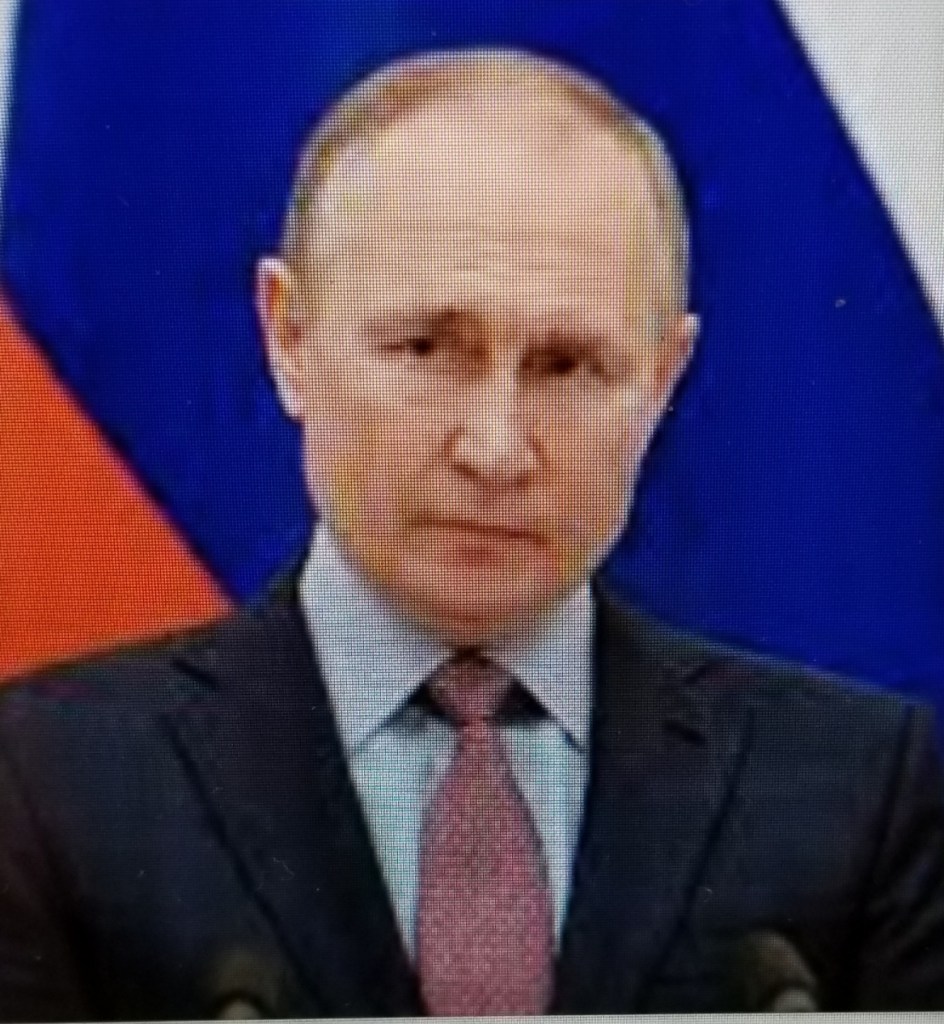
One must admit admit Vlad the Bad is a dapper dresser. He may not be given to smiles, but he is neat. Vladimir looks a little concerned in this image. Is he having second thoughts about something that he did?
What a complicated guy Czar Vlad has turned out to be. Bad to the bone for sure, his latest activities, aka The Invasion of the Ukraine, makes one wonder what makes this guy tick? How will that event unfold. Where will the war in Europe go? Nobody knows for sure.
As to the true identity and character of Vladimir Putin, that also is a mystery.
BCE (aka Buffalo Chip Express) has several theories:
Grigori Rasputin was not so given to the neat and clean shaven look. His haunted hairy face is nicely complimented by the dark sunken eyes. Yes, this is a guy who could really screw things up.
The Reincarnation of Rasputin: this is a pretty good theory. Let’s start with the hard fact that the name Putin shares 5 letters with the name Rasputin – that cannot be a coincidence! And those 5 letters are in the exact same order. This theory becomes even stronger when you consider that Rasputin single handedly screwed up the 300 year rule of the Romanov Dynasty and helped bring on the Russian Revolution. It presently looks like Vlad the Bad is on a similar trajectory. This theory looses some of its momentum when you consider that Rasputin was a monk given to seducing Princesses in the Court of the Czar and drinking vodka until senseless. That part, however, does not seem to fit the MO (modus operandi) of Vlad the Bad.
Yes, Vlad the Bad is bad, but he is not known to have been a monk, to seduce Russian princesses or to drink himself senseless. So perhaps, this theory is not as solid as it might be. Of course, it could be that Vlad the Bad has a secret life of seducing the great grand daughters of former Russian princesses and is a closet drinker. If so, that is a well-kept secret within the high walls of the Kremlin.
So let’s move on to the next possible theory –
Ivan the Terrible was really terrible and in terms of grabbing land he was a real winner.
Ivan the Terrible Reborn: This theory has some legs. Vlad the Bad does share characteristics that might make Ivan the Terrible jealous. The Invasion of Ukraine is certainly something that Ivan the Terrible would do, although Ivan would no doubt go along to the Ukraine himself (and not sit back in Moscow like Vlad the Bad), bringing one or two of his sons that he had not yet killed. They would no doubt take part in torturing and raping as many citizens of the Ukraine as they could come across. And Czar Putin’s previous forays into Georgia and the Crimea would win high marks with Ivan because that the kind of guy he was – he liked land grabs. Still, this theory gets a little shaky when we study the portraits of Ivan the Terrible and Vlad the Bad.
Ivan the Terrible was probably pretty terrible when it came to grooming whereas Vlad the Bad is a neat, well-dressed and buttoned up autocrat. Appearances seem to be important for Vlad the Bad whereas not so much for Ivan the Terrible.
This brings us to last possible explanation –
Napoleon Before Waterloo – there was a time when it looked he was going to be the Conqueror of Europe, but things went South at Waterloo and Bonaparte ended up on the island of Saint Helena. If you look closely at Napoleon’s face, it does resemble Vladimir’s face. Can that be a coincidence?
Napoleon in Reverse: If the Ivan the Terrible comparison has some legs, BCE thinks Napoleon in Reverse is a wrap. Let’s start with the obvious – both guys are snappy dressers and both guys are short dudes – Bonaparte was 5’ 6”, Vlad was 5’ 7”. Both seemed to have a chip on their shoulder and both had a bent towards megalomania. Let’s bring the case home: Napoleon invaded Russia and had to retreat when things did not work out. Vlad the Bad invaded the Ukraine and may have to retreat if things do not work out.
That may not seem like a direct comparison but that depends on the outcome of The Invasion of Ukraine. If Vlad the Bad is forced to retreat and cut a less than perfect deal, as BCE suspects, then truly, Vlad the Bad will be Napoleon in Reverse.
Of course, quite the opposite could occur if Vlad the Bad decides to go West.
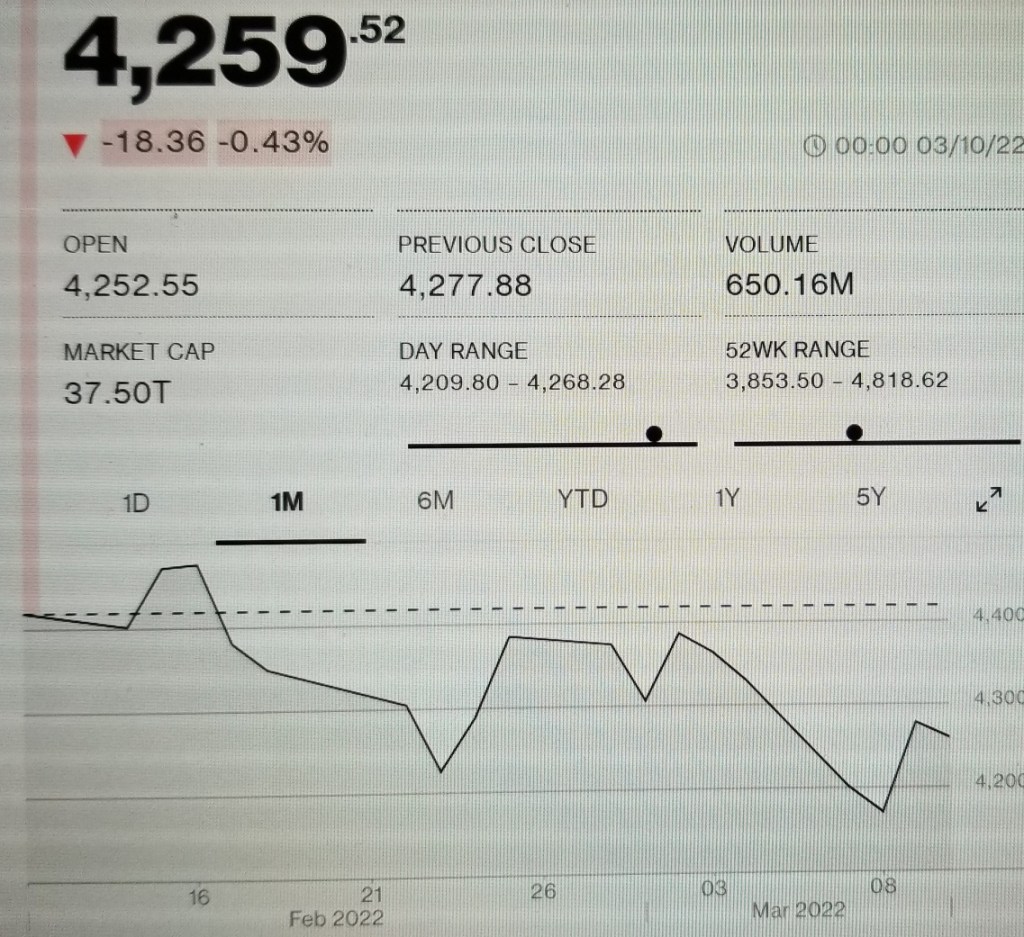
The last 30 days has had its ups and downs as can seen in the chart above. The markets have been greatly influenced by the events of the Russian invasion of Ukraine. Today, Czar Putin said the have been “some positive developments” in negotiations. Before the opening this morning (3/11/22), the market futures surged over 2% and oil declined slightly. Just before the opening the markets fell back. The day is young and who knows what new assessments and changes a full day of trading will bring.
Pundits, economists, Financial Broadcasters, CNBC, Bloomberg, Fox Business News and various finance publications all agree – markets are the true barometer of the health of our economy and the font of all wisdom. For this reason, it is instructive to review the recent path of various market moves to see what truths they reveal.
For 5 days leading up to the invasion of Ukraine, markets trembled with stocks declining everyday. Thereafter, the market both soared and repeatedly sank. By the first week in March, the markets were generally down and as the days passed, the markets went down more. There was a miracle upturn in the beginning of the second week of March, but the course of the market was still described by some market observers as “choppy”.
The invasion of Ukraine proved to be far more extensive then originally thought. Czar Putin moved his forces into Ukraine from four different directions, but so far they have they have not moved much from their original entry points. To the surprise of many, the Ukrainians defended themselves in heroic and surprising ways and after almost two weeks, while the Russians had made advances in the South of Ukraine, they still had not captured any large Ukrainian city.
The markets adjusted dramatically to the ups and downs of the war by dramatically going up and down on various days with the hopes of a quick solution early in the invasion fading and the reality of a drawn out invasion rising as the first 15 days passed. The reasoning of markets was that an invasion of Ukraine might be bad for the markets and, maybe even, for the economic health of the world economy. No doubt it would raise the price of gas and this would further raise prices in the U.S. Who knows, the FED may have to raise interest faster or slower.
To the surprise of many, Ukraine has withstood the initial attacks of the Russians and has inflicted casualties on Russians and damage to Russian tanks, planes and helicopters. This slowed the Russian invasion and troop movements became bogged down in several parts of the country. It would seem the Ukrainians were better prepared and better armed than originally thought. At the same time, the U.S., the UK. and the EU instituted some sanctions. And as the days passed they issued more sanctions almost every day.
While NATO and U.S. were unwilling to either establish a “no fly zone” or commit troops in the Ukraine, they eagerly sent in weapons and missiles and rocket launchers from surrounding countries. So, not only did the Ukrainians fight far more ferociously than the Russians had planned, it turned out that the Ukrainians were able to get access to lots of weapons.
And while the Russians and Ukrainians were warring and the U.S., EU and UK were sanctioning, the price of oil rose to over $100.
On the second day of the invasion, word came that Czar Vlad might entertain talks with the Ukrainians. Of course, there were a couple minor conditions: The Ukrainian military would have to surrender. Ukraine would have to become “de-militarized and de-nazified”. The price of oil fell a bit and the markets soared on this news.
Peace talks took place and nothing happened and the markets took a breather and considered the situation. And then the Russian invasion resumed. To the surprise of even more analysts, the Russian attacks were met with continued fierce resistance from the Ukrainians. In the meantime, the U.S., the UK and the EU instituted more sanctions and sent in more weapons.
The Russians shifted military techniques doubling down on bombing and shelling and indiscriminate murder of civilians and destruction of buildings, schools, hospitals, towns and cities. The markets continued on their jagged course, up a day or two and then down for several days in a row. And as the chart above indicates, the general direction drift of markets were down, while the general direction of the price of oil was up.
Within the markets, the pundits deliberated the daily happenings and considered the most important issues of each day…do we buy on the dips, will the S&P break 5,000 by year end, will their be a cost increase in Billionaire homes in The Hamptons this summer, will the war extend to NATO, could World War III affect stock option trades?
Ivan the Terrible was Russia’s first bad Russian guy. In 1569 to 1570, when the Archbishop of Novgorad was giving Ivan a little trouble, he and his sons and the Russian Army journeyed from Moscow to Novgorod killing, raping and burning everything on the way and everything there when he got there. From the 9th century on, the Ukraine has bounced back and forth under control of Russian, Turkish and Polish princes. In 1653, the second Romanov Czar decided to grab back the Ukraine from Poland. In 1668, the Ukraine was put under the protection of Mohammed IV. Ever since, the territory of the Ukraine has been argued over.
February 25th, 2022 –
If one has studied Russian History, you will discover a long line of Czars and bad guys and bad gals starting with Ivan the Terrible and passing on to Peter the Great, Catherine the Great & Stalin. And if one looks at what these different people did, one fact seems to stand out…they all increased the size of the Russian empire and they all were concerned with having ample land surrounding their empire. One could say that having satellite countries is built into the DNA of Russia.
Enter Vlad the Bad. Vladimir has been with us for a while, first as a KGB agent, later as Premier and President of Russia. In truth, Vlad the Bad is just another Czar who has spent a lifetime consolidating power and increasing the size of the Empire. Czar Vlad’s view may be a little short-sighted when compared to his predecessors: he looks back to the glory days of the Soviet Union and seemingly considers that the apogee of Russia. No doubt, earlier Czars and Czarinas would disagree with him on that point. They might think that the former Communist Empire was a step down in elegance, glory and achievements of previous Czars and Czarinas.
This same view may be harbored by the Russian people themselves, but no matter, you go to war with Czar you have, not Czar you wish you had.
For those of you not familiar with Russian History it should also be noted the Ukraine, Kyiv and the Dnieper River have long played major roles in the history of Russia. So, if you are thinking that Vlad the Bad is the first Russian to think that the Ukraine was a part of Russia, you would be wrong. The Ukraine has been thought by Russians to be a part of Russia for over a 1,000 years. For as long as there has been a Russian Empire and an area known as the Ukraine, Russians have thought that the Ukraine is Russian.
This is not say that the people living in the Ukraine have the same view of history. Like Jerusalem, the history of the Ukraine is far more complicated. True, the Ukraine was an original part of Russia dating back to the 9th century, but after that it was under various masters. The days that Vlad the Bad fondly remembers was when the ”Iron Curtain” had descended and the Ukraine was fully under the control of Mother Russia. First and foremost, the people living in Ukraine did not necessarily have the same fond memories of the Good Old Days of the Cold War. Perhaps, they remembered some shortages in supermarkets or in nylons for the ladies.
But time and history move on and The Wall did fall and the former satellite countries of the Soviet Union became more interested in enjoying their lives and in having some say in their destiny. And other things were happening in the world. The EU was founded in 1993 and like any growing organization they sought new members to augment their numbers. Now it must said that that there was a guy named George Kennan who formulated for the United States a theory of containment for the Soviet Union. George quite correctly said that the Soviet Union would never be happy unless it had its satellite countries. And shortly before George died, he said that European and Western diplomats had screwed up everything and not understood Russia’s need for satellite countries and surely trouble would come from that.
Certainly, George was right about that but as with all things that have happened it must be remembered that they are in the past and the past is the past. So, pushing forward to the present moment, you can say there may be some reasons why Vlad the Bad is being bad and that it all could be explained as just being in Czar Vlad’s DNA. So this is the moment we are at. The U.S. and Europe can say there is no justification for Putin’s ”War of Choice” and Putin can simply say the answer is history itself and I need my Ukraine.
So where will all this go? Nobody can know. Calmer and more mature and perhaps, more naive minds can hope for a diplomatic settlement. More realistic folks can hope that the invasion is swift and clean and not too many people are murdered. More pessimistic folks can hope we avoid World War III. Still more pessimistic folks might just say things come in 3s.
This is the little area of Hong Kong, Shenzhen, Dongguan and Guangzhou. 50,000,000 folks reside around this little coastal waterway.
February 16th, 2022 – Today President Xi ordered Hong Kong officials to get the recent surge of the Omicron wave of Covid under control in that city. The city of Hong Kong has just announced 4,200 new Omicron cases and 3,000 new suspected Omicron cases.
President Xi said,
“Hong Kong’s government must take up the main responsibility to stabilize and control the pandemic as soon as possible as a mission that overrides everything, mobilize all available forces and resources and take all necessary measures to ensure the safety and health of Hong Kong’s citizens and the stability of Hong King’s society.”
Some news organizations speculate that China may soon order a total shutdown of Hong Kong and the adjacent new territories. The population of Hong Kong is roughly 7,500,000 people. The population of the new territories is roughly another 3,600,000 people. So, 11 million or so folks may soon find themselves in lockdown.
As many of you may know, China has Zero Covid policy and that has not been easy. China has routinely shut down cities with millions of people living in them when only one or two Covid cases were found. The situation in Hong Kong appears to be of a different magnitude and obviously Emperor Xi is somewhat concerned.
Throughout history various Kings, Emperors, Dictators and Leaders have decreed unpleasant things to go away. The English King Canute in the 12th century commanded an incoming tide to halt and not wet his feet and robes. To Canute’s surprise, the tide kept coming and his feet and robes got wet. That encouraged Geoffrey Chaucer to say a few hundred years later ”time and tide wait for no man”.
BCE (aka Buffalo Chip Express) would like to point out that Hong Kong is situated on the Pearl River and adjacent to a number of large mainland China cities. Locally, that area of Southern China, is considered to be one giant ”sea city” of 50,000,000 people. As many travelers to Hong Kong know, there is a lot of people going back and forth between Hong Kong, Shenzhen, Dongguan and Guangzhou and these four Chinese cities are all within 50 miles of each other.
BCE speculates that it could happen that the dread Omicron epidemic now spreading through Hong Kong could also spread to the adjacent cities of Shenzhen, Dongguan and Guangzhou. BCE might make an additional guess and say that if that does happen, the Omicron virus may spread throughout the mainland of China this coming spring and summer.
If that were to happen, it could be thought by some in China that President Xi, the present Emperor of present Chinese dynasty, has no clothes.
Sometimes many people say the same thing and sometimes those people are wrong.
February 15th, 2022 – There are two interesting theories on why prices may go down in the coming months. These two theories are promoted widely by prominent pundits, financial advisers, TV business commentators, economists, bankers, stock market mavens and other like-minded folks.
Prices will go down because inventories are presently at an all time high.
High prices will go down as the disruptions caused by the Pandemic go down.
Let us consider the first theory – inventories are at an all time and therefore prices will go down. First, it is not quite true. In December inventories of all unsold goods reached 789.4 billion. That was 2.5% increase over November, but actually that was a decrease over inventories in October, 2021. No matter, it is beyond dispute that inventories were historically high in December, 2021.
That said, BCE (aka Buffalo Chip Express) asks why would that decrease prices in the future? BCE knows the theoretical answer to that question. It goes like this: Because inventories are historically high, sellers of goods will be forced to reduce prices on those goods. BCE admits it may be quite true that having too much inventory of a product at one time may force some sellers to reduce prices in order to sell down those high inventory items, improve cash flow and be able to buy other goods, but BCE would suggest that does alter the fact that those goods were produced at higher prices. And more particularly, that does not, in itself, reduce the future cost prices to replace those products in the future.
So, BCE would agree that high inventories may force some sellers to reduce the prices of some products temporarily, but that does not change the cost of producing new goods in the future, nor does it mean that prices will not again go up in the future for those products. Finally, just having high inventories of some products does not mean they will reduce prices on those products at all. Sellers may just hold those products in stock until they they are sold at the higher prices they have passed on.
The second theory is as the Pandemic and the disruptions it caused wind down, price increases will go down with it. BCE sees 2 problems with this idea:
It is not clear that the Pandemic or the disruptions it caused will go away. While it is clear that the Pandemic is presently winding down from the present winter surge in the U.S., it is not clear or knowable that there will not be further surges or new variants of the Pandemic to cause further disruptions. In addition, it is not clear that disruptions in Asia and Europe and other places around the world will go down and will not suffer further surges or variants in the future.
In particular, it is clear that the Pandemic is surging rapidly in Hong Kong and may spread soon to all of China and that would almost certainly guarantee further disruptions of production and shipment of goods. And if that were to happen, it would add further pressure on prices. It is not clear that even if the Pandemic and disruptions from it declined, there would be any reductions in the cost of goods or the cost of shipping goods. In fact, if the Pandemic recedes and disruptions cease, it may cause further price increases because the reopening of economies cause a major increases in the demand for goods.
Again, people can speculate that prices may magically go down, but they will never know if prices will magically go down until that actually happens.
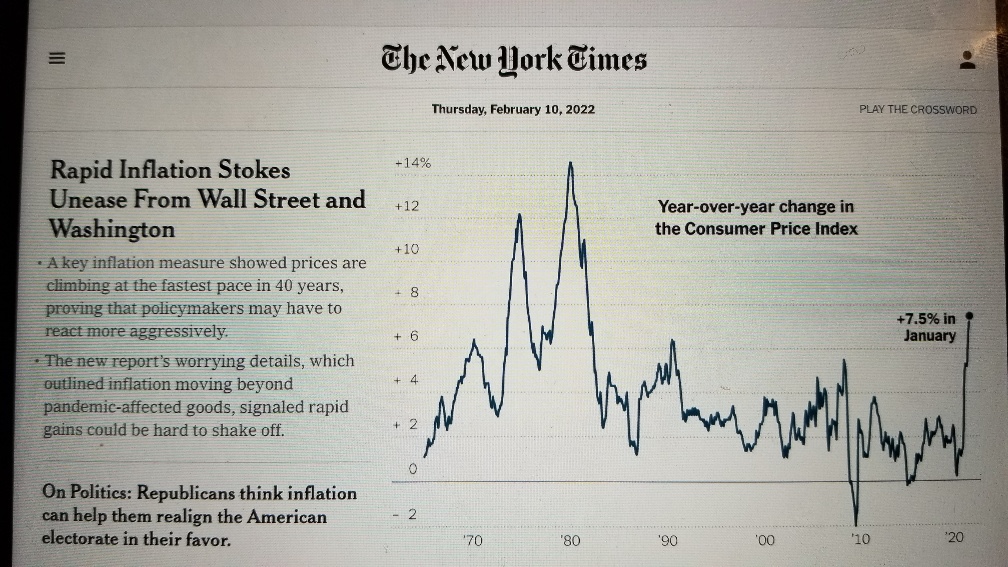
Today it was announced that inflation for last month, January, surged 7.5%. The experts, the pundits, the stock market mavens had forecast anywhere from 5% to 7.2%. Surprise, surprise – inflation turned out to be like that ornery child who refuses to behave. It was supposed to go down slightly, but it actually sped up.
Until recently, the Fed had proclaimed inflation “transitory”. Chairman of the Fed, Jerome Powell, retired the word “transitory” at the end of November when it became apparent that inflation was increasing rather than decreasing. Apparently, the Chairman was surprised that inflation was actually accelerating. Who knew?
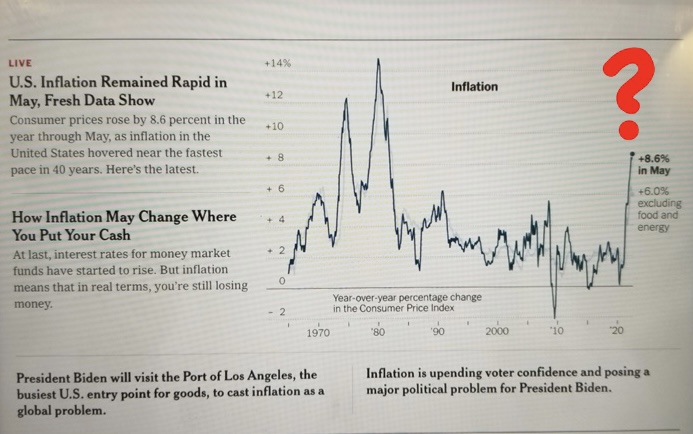
As one can see from this chart, inflation has varied greatly in the last fifty years. Inflation was pretty high in the 70s and early 80s and then it calmed down for almost 30 years until a couple of months ago.
There are many reasons for inflation:
Cost of materials went up worldwide, increasing the cost of producing products worldwide. Cost of shipping products went up worldwide. The Pandemic caused unemployment and shutdowns that slowed production of many products worldwide, adding to the costs of producing products.
With advent of the Pandemic, the U.S. Government launched large relief packages to assist people and companies, literally printing and dispersing billions of dollars. The increase in the printing of money increased the yearly deficits of the United States, but it also devalued the currency because the added spending was not offset by added income to the government.
And because inflation increased rapidly in the United States, many workers requested and held out for wage increases. And because businesses had difficulties hiring and getting people, they were forced to increase the wages they paid. At the same time, the people accepting new jobs at higher wages quickly found the price increases of everyday products they bought was accelerating faster than their salaries.
All of these factors had an influence on the prices of products and services in the United States. It was thought by the best and brightest in the economic community that these increases were short-term or in the words of Chairman Powell, “transitory”. But as mentioned, right up to this week, inflation had the nasty habit of increasing rather than decreasing.
The best and brightest of the economic community still believe that increases are only “transitory” and almost all forecasts are for inflation to sharply decrease by year end.
BCE, aka Buffalo Chip Express, would like to suggest that the predictions of a sharp decrease of inflation by year end may not happen.
BCE would like to suggest that the higher cost of goods and services and materials and wages may only be beginning.
BCE would like to mention that when goods are produced in other countries, the manufacturers of those goods pass on higher costs only as they occur. And in truth, exporters only began to pass on higher prices about 6 months ago. However, the companies importing and selling those goods in the United States did not raise prices immediately because they had stock of goods already bought at lower prices. Most companies try to raise prices only once a year. So, most companies only began their price increases of imported goods in January of this year.
BCE would like to also mention that just because an importer has announced price increases, that does not mean the price of the goods go up immediately in stores. That is because stores also have inventory and they tend to raise their prices only as they receive new goods that they have to pay more for. So, the process of passing on price increase takes time and BCE would suggest that many price increases announced by exporters 6 months ago will only show up in retail outlets at the consumer in the next 3 months.
Of course, not all goods sold in the United States are imported. We still do manufacture a lot of goods, but in manufacturing, a lot of inflationary factors are also at play. The fact that we are still in Pandemic has greatly added to the costs of manufacturers, because they have experienced added costs for the times they have had to shut down, for the times they had people out sick, for the increases in wages that they have to pay, for the increases in shipping costs both shipping parts and materials to them and shipping finished goods to their customers. And, of course, they have had to pay increased prices of materials and parts that they need for the production.
So U.S. manufacturers have seen many costs rise and are still seeing costs rise. And manufacturers, like importers, generally only pass on price increases when price increases are passed on to them. But make no mistake: they must pass on price increases if they are to be profitable and remain in business.
BCE would like to note another factor looming over the U.S. economy and that is the price of oil. On the same day that the government announced 7.5% inflation, the price of oil hit $90 several times that day. The price of oil has in the last 18 months increased from a low of $40 to the present high of $90+.
Those of you familiar with what is known as the “driving season” might remember that the price of oil has a mysterious tendency to increase in the spring and summer when most people drive a lot. This coincidence seems to occur fairly consistently over the last 50 years. And, of course, if it was to occur this year, it would probably mean that the price of oil is about to head up the mountain on a journey from $90+ to $130+ or more.
Of course, history and coincidences don’t always occur, but they do, as Mark Twain noted, tend to rhyme. So, BCE guesses that we will see a further sharp rise in the price of oil this spring and summer. As most you know, that probably means that the price of gas, presently anywhere from $2.50 a gallon to $4.50 a gallon, might be $5 to $7 this summer.
Economists speak of oil shocks, but this truly would be a “gas shock”. No change like the above comes about without creating other changes. As people notice the price of gas going up weekly they will realize that inflation is taking more and more of their salary and as that happens there will be an increase in the demand for higher wages. So, the likelihood is that manufacturers and stores and hospitals and hotels and convention centers and water parks and airlines and banks and all other businesses will find themselves with employees wanting more wages.
BCE would like to point out that the difficulties from an oil shock and a gas shock do not stop there. Plastics are a derivative of oil and so all parts and any products made using plastic are likely to go up sharply this spring and summer. And of course, all of these price increases will only start feeding into our economy this spring and summer. And because the lag time between material price increases and product price increases is long, the real impact may only be felt in the fall of this year and in the first 6 months of 2023.
To summarize, BCE thinks the thought that prices will moderate sharply in the coming months is Buffalo Chips.










 Buffalo Chip Express